Designing Eco-Friendly Bouquets at Home Without Special Tools
If you love flowers but hate the waste, the wasteful packaging, or the feeling that you need a drawer full of florist gadgets just to make something lovely, you are in the right place. Designing eco-friendly bouquets at home without special tools is refreshingly practical: it's about using what you already have, choosing flowers responsibly, and arranging them in a way that looks generous without creating unnecessary rubbish. Truth be told, the best home bouquets often come from a simple mug, a pair of kitchen scissors, and a little patience.
This guide walks you through the full process in plain English. You'll learn how to choose seasonal blooms, reduce plastic, build a bouquet with everyday household items, and keep it looking good for longer. We'll also cover common mistakes, best-practice care, and a few real-world decisions that make the difference between a bouquet that feels thrown together and one that feels thoughtful. If you want to understand the wider flower journey too, it can help to look at a florist's sustainability approach and the practical advice on flower care once your arrangement is finished.
Expert summary: The most eco-friendly bouquet is usually not the most elaborate one. It is the one that uses seasonal stems, minimal packaging, reusable containers, and sensible cutting and conditioning at home. Simpler, yes. Boring, absolutely not.
Table of Contents
- Why Designing Eco-Friendly Bouquets at Home Without Special Tools Matters
- How Designing Eco-Friendly Bouquets at Home Without Special Tools Works
- Key Benefits and Practical Advantages
- Who This Is For and When It Makes Sense
- Step-by-Step Guidance
- Expert Tips for Better Results
- Common Mistakes to Avoid
- Tools, Resources and Recommendations
- Law, Compliance, Standards, or Best Practice
- Options, Methods, or Comparison Table
- Case Study or Real-World Example
- Practical Checklist
- Conclusion
- Frequently Asked Questions
Why Designing Eco-Friendly Bouquets at Home Without Special Tools Matters
Flowers are meant to bring life into a room, not create a pile of plastic, foam, and throwaway extras. That is the heart of this topic. Eco-friendly bouquet design at home matters because it helps you enjoy flowers in a way that feels lighter on the environment and, often, lighter on the wallet too. You do not need floral foam, wire cutters, tape guns, or a professional studio setup. You need awareness, a few simple habits, and a willingness to work with the flowers rather than forcing them into a rigid shape.
There is also a bigger picture. A bouquet can be beautiful and still be wasteful if it uses a lot of packaging, imported out-of-season stems, or items that can't easily be reused. Designing with sustainability in mind means thinking about the whole life of the arrangement: where the flowers came from, what they are wrapped in, how long they last, and what happens after they fade. If you're curious about the values behind that mindset, a florist's about us page and their modern slavery statement can offer a useful window into how they think about responsible sourcing and business practices.
And then there's the simple pleasure of it. A late-afternoon kitchen table, stems spread out in a jam jar, a little leaf-scrap scent in the air - it feels personal. Not showroom-perfect. Better than that, actually.
How Designing Eco-Friendly Bouquets at Home Without Special Tools Works
The process is less technical than many people expect. Instead of relying on specialist mechanics, you build the bouquet around structure, balance, and freshness. In practical terms, that means using everyday items for support, keeping the stem choices sensible, and arranging in layers so the bouquet holds itself together naturally.
At the simplest level, the method works like this:
- choose flowers and foliage that suit the season and your space
- prepare a clean container or wrapping surface
- strip leaves that would sit below the waterline
- cut stems with a normal kitchen knife or scissors if that is what you have, though a sharp clean blade is better
- place the strongest stems first to create a loose framework
- fill gaps with softer blooms and greenery
- finish with water, reuse-friendly wrapping, or a simple tied bundle
The point is not to mimic a florist's workstation line by line. It is to understand the logic behind the design. Strong stems create support. Softer flowers add texture and colour. Foliage gives the eye somewhere to rest. Once you see the bouquet as a small system rather than a pile of flowers, the whole thing becomes far easier.
Home floristry also benefits from restraint. A mixed bunch can look more elegant when you edit it slightly. Remove damaged petals, trim excess leaves, and let the bouquet breathe. If your flowers arrive by post or from a local florist, check the practical delivery and handling details on flower delivery and delivery information so you know what to expect before you start arranging.
Key Benefits and Practical Advantages
There are several reasons this approach has become so appealing, especially for people who want something beautiful without turning their home into a crafting workshop.
1. Less waste, more reuse
You can often make a bouquet using containers and materials you already own: jam jars, glasses, old ceramic jugs, repurposed tins, or a clean vase that has been sitting in a cupboard for ages. That means less disposable plastic and less need for single-use extras. The bouquet itself becomes the focus.
2. Lower cost without looking cheap
To be fair, flowers can get expensive. But an eco-conscious arrangement often uses fewer stems more thoughtfully. Seasonal flowers, locally available blooms, and a simple layout can look far more refined than a crowded arrangement. The trick is not abundance alone; it is proportion.
3. Easier for beginners
If you have ever looked at florist tools and thought, "Right... where does one even begin?", this is the gentler route. No special equipment means fewer barriers. You can start with what you have, learn by doing, and improve each time.
4. Better flower longevity when done properly
Fresh cuts, clean water, and sensible stem placement often matter more than expensive tools. A bouquet with carefully conditioned stems will usually outlast one assembled quickly without attention to detail.
5. A calmer, more intentional process
There is something quietly satisfying about making a bouquet in a slow, human way. You notice the scent of eucalyptus, the bend of a tulip stem, the odd leaf you should probably remove. It slows you down a bit. In a good way.
Who This Is For and When It Makes Sense
This approach suits a surprisingly wide range of people. You do not need to be "into crafts" or especially artistic. If you like flowers and want to handle them thoughtfully, you are already most of the way there.
It makes sense if you are:
- making flowers for your home and want a lower-waste option
- putting together a small gift bouquet for a neighbour, friend, or relative
- trying to avoid floral foam and disposable accessories
- working with a limited budget
- learning basic flower arranging for the first time
- planning a simple table arrangement for a meal, birthday, or quiet occasion
It is especially useful when:
You want something last-minute and do not have florist tools to hand. You have flowers from a local market, garden cuttings, or an online order. Or you simply want to keep things low-key and sustainable. Sometimes the nicest bouquet is the one made on a Tuesday evening because the kitchen looks a bit bare and you want to cheer it up. No occasion required.
If you need a broader sense of how a reputable florist handles customer support and aftercare, the pages on guarantees and returns and refund are useful for understanding service expectations when you buy flowers rather than cut them yourself.
Step-by-Step Guidance
Below is a practical method for making an eco-friendly bouquet at home using ordinary items. The goal is not perfection. The goal is a bouquet that feels balanced, fresh, and honest.
Step 1: Gather what you already have
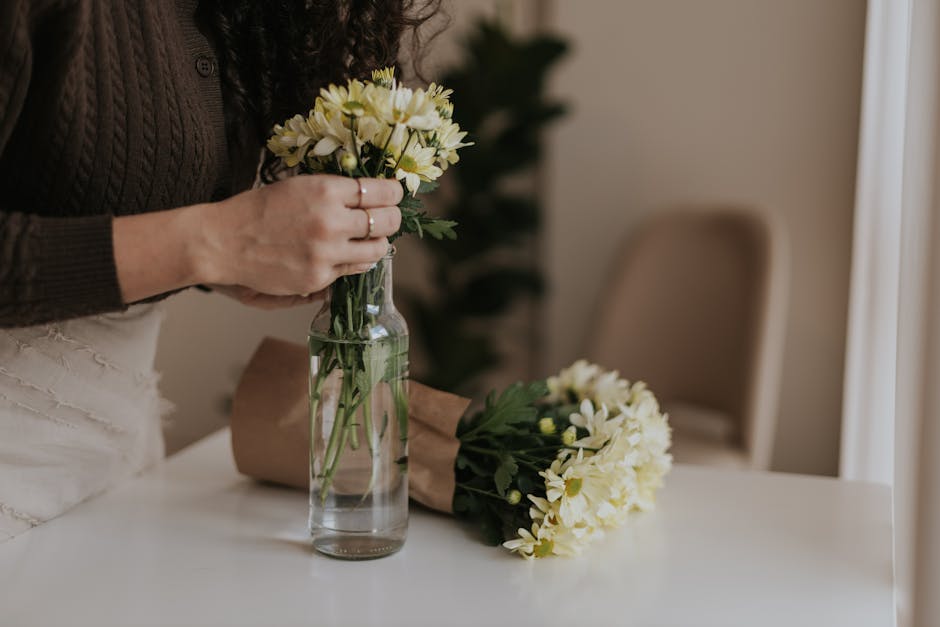
Start with a clean vase, jar, or jug. Pick up household scissors or a sharp knife, a clean cloth, and some water. If you have a bit of string, twine, or a soft ribbon, keep that nearby too. Avoid plastic ties or anything you will immediately throw away.
Step 2: Choose your flowers with sustainability in mind
Seasonal, locally grown flowers are often the most sensible choice. They tend to suit the climate, travel less, and feel more naturally in tune with the time of year. Think spring tulips, summer sweet peas, autumn dahlias, or winter greenery with a few sturdy blooms. You can also use garden cuttings - rosemary, viburnum, ivy, mint, or hardy foliage can be surprisingly useful.
Step 3: Clean and condition the stems
Remove leaves that would sit under water. Cut stems at an angle if you can. If you are working with flimsy flowers, keep the cuts clean and do not crush the ends. A kitchen knife can work in a pinch, but make it deliberate and safe. No heroics needed. Place stems in water straight away.
Step 4: Build the structure first
Use a few stronger stems to create the shape. These might be branches, foliage, or thicker flowers like roses or chrysanthemums. Spread them a little so the bouquet has width. Then add medium stems to create a loose dome or one-sided shape, depending on the style you want.
Step 5: Add focal flowers and fill the gaps
Focal flowers are the ones your eye lands on first. Place them where they can breathe, not all bunched together in one heavy clump. Then add smaller blooms or filler stems around them. Move the bouquet around as you work. Step back, squint a bit, and check whether one side is doing all the talking. Usually it is.
Step 6: Finish with water and simple wrapping if needed
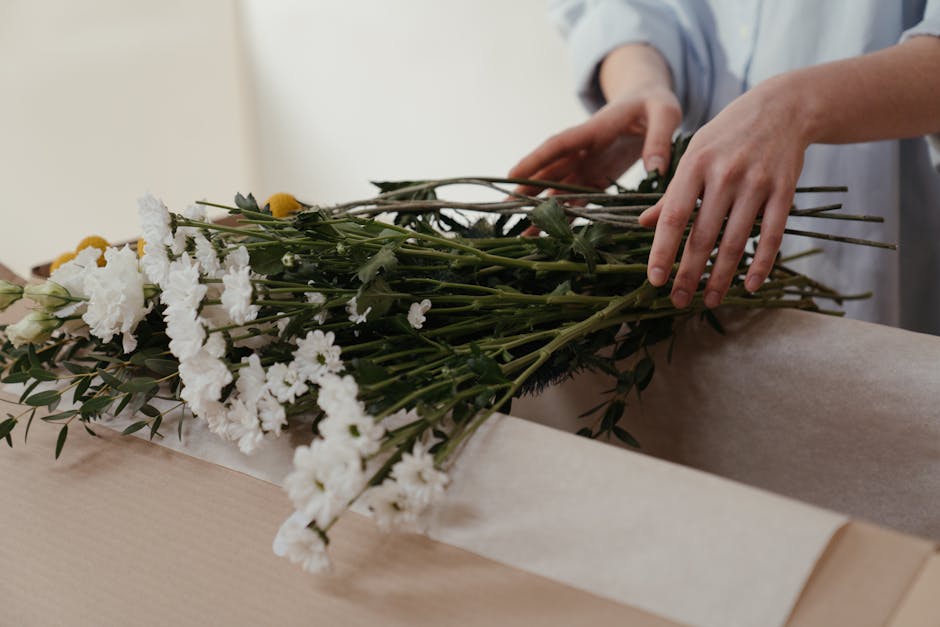
For a vase arrangement, fill the container with clean water and make sure nothing is below the surface that should not be. For a hand-tied bouquet, hold the stems in one hand, adjust the shape, and tie gently with string or ribbon. If you are giving it away, wrap it in plain paper or reusable cloth rather than plastic where possible.
Step 7: Set it somewhere suitable
Keep the bouquet away from radiators, fruit bowls, and direct sunlight. Fruit gives off ethylene gas, which can shorten the life of some flowers. A cooler room is usually kinder. A little like the flowers themselves prefer a quieter life, really.
Expert Tips for Better Results
Here is where the small improvements make a noticeable difference. None of these requires special tools, but together they make your bouquet look more considered.
- Use odd numbers when grouping focal flowers. Three, five, or seven blooms often look more natural than a rigid even count.
- Mix textures, not just colours. Soft petals next to feathery greenery create depth.
- Keep some negative space. A bouquet that is too tight can look flat and trap moisture.
- Re-cut stems after a day or two. Fresh cuts can help with water uptake, especially if the arrangement is drooping.
- Change the water regularly. Clean water is one of the simplest ways to extend vase life.
- Use what is already abundant. Garden cuttings, leftover greens, and flowers at the edge of freshness can still look wonderful if they are handled carefully.
One useful rule of thumb: if a stem is weak, use it as an accent rather than a structural piece. If a flower is too open and floppy, place it higher in the bouquet where it can cascade naturally. Small adjustments like that are what make a home arrangement feel intentional rather than improvised.
And yes, sometimes you need to move one flower ten times before it looks right. That is normal. Annoying, but normal.
Common Mistakes to Avoid
Even simple bouquets can go wrong in the same few ways. The good news is that most of the problems are easy to prevent.
Using too many different flowers
A mixed bunch can become visually noisy if every stem is shouting for attention. A narrower palette often looks more elegant and more cohesive. Two or three flower types, plus greenery, is often enough.
Ignoring stem health
Brown ends, limp leaves, and damaged petals shorten vase life. Remove anything that looks tired before you begin. A little editing up front saves disappointment later.
Overpacking the bouquet
More is not always better. If stems are jammed together, airflow suffers and the shape becomes awkward. Give the bouquet some room to move.
Using dirty containers
Old residue in a vase can spoil the water faster than people realise. A quick wash makes a real difference. Nothing glamorous here, just good sense.
Leaving leaves below the waterline
This is a classic mistake. Leaves in water encourage bacterial growth and can make flowers fade earlier. Strip them off before arranging.
Choosing flowers without thinking about the setting
A dramatic tall bouquet may look wonderful on a wide table but awkward on a narrow shelf. A tiny posy can disappear in a large hallway. Scale matters, even when the flowers are lovely.
Tools, Resources and Recommendations
You really do not need special tools, but a few ordinary household items help make the process smoother. Think practical, not fussy.
| Item | Why it helps | Eco-friendly alternative or note |
|---|---|---|
| Kitchen scissors or a clean knife | For trimming stems | Use what you already own; keep it sharp and clean |
| Glass vase, jug, or jar | Supports the arrangement and holds water | Reuse old jars or upcycle a container from home |
| Twine or ribbon | Useful for tying hand-tied bouquets | Choose natural fibre where possible |
| Clean cloth | For wiping stems, hands, and surfaces | A washable tea towel is usually enough |
| Plain paper | Good for wrapping gift bouquets | Avoid glittery or plastic-coated wrap |
If you are buying flowers rather than cutting them from the garden, it helps to work with a supplier that is clear about service and customer care. The pages on payment, flower care, and contact us can be useful references for what a good customer journey looks like and how to get help if you need it.
For readers who want to understand trust signals and business standards, it is also worth checking public-facing policy pages such as privacy policy and terms and conditions. These are not part of the bouquet-making process itself, of course, but they do tell you something about how seriously a business treats clarity and responsibility.
Law, Compliance, Standards, or Best Practice
For a home bouquet, there is usually no complex legal framework to worry about. Still, best practice matters. If you are buying flowers from a florist in the UK, it is sensible to look for clear information on delivery, care, refunds, and company policies. That does not mean every arrangement has a formal standard attached to it, but it does mean the seller should communicate clearly and honestly about what is being provided.
If you are giving flowers as a corporate gift or for an event, additional expectations may apply around invoicing, reliability, and consistency. In that context, a service such as corporate accounts can be helpful because it signals structured ordering and support. That is more about operational professionalism than bouquet design, but it matters when flowers are part of a business setting.
There is also a practical duty of care around food and fragrance sensitivity if flowers will be displayed in shared spaces. Strongly scented blooms can be lovely, but not everybody wants a powerful perfume on a meeting table or in a small room. Common sense goes a long way here. So does asking, quietly, whether the recipient is likely to appreciate lilies, hyacinths, or heavy scent.
Finally, if you are choosing flowers with sustainability in mind, the most reliable standard is often transparency: where the flowers came from, how they were handled, and what materials were used in packaging. That is why sustainability information matters. It is not about moral perfection. It is about making informed choices.
Options, Methods, or Comparison Table
There are several ways to design an eco-friendly bouquet at home. Each has a slightly different feel, and the best one depends on what you have available. Here is a simple comparison.
| Method | What you need | Eco impact | Best for |
|---|---|---|---|
| Vase arrangement | Container, water, scissors, flowers | Low waste if the vase is reused | Everyday display, easiest starting point |
| Hand-tied bouquet | Flowers, string, paper or cloth for wrapping | Very low if wrapping is minimal and reusable | Gifts, market flowers, casual celebrations |
| Garden gathered mix | Homegrown stems, foliage, a jar or jug | Very low, especially with no packaging | Seasonal home arrangements, relaxed style |
| Mixed foraged greenery with flowers | Carefully selected safe foliage and a few blooms | Low, if taken responsibly and sparingly | Natural-looking displays with texture |
A useful way to decide is to ask yourself one question: what do I already have? If the answer is "a clean jam jar and some supermarket flowers," then start there. If the answer is "a few roses, rosemary from the garden, and a piece of string," that works too. The bouquet should fit the materials, not the other way around.
Case Study or Real-World Example
Imagine a small Saturday evening bouquet for a kitchen table. Nothing grand. Just something to brighten the room before guests arrive on Sunday.
You begin with three supermarket roses that are just opening, a few stems of eucalyptus from a previous arrangement, and some rosemary cut from the garden. Instead of reaching for floral foam or decorative plastic, you grab a clear glass jar. The jar is washed, the stems are recut, and the lower leaves are removed. The rosemary goes in first because it gives shape and scent. The eucalyptus adds a soft, silvery backdrop. Then the roses are placed slightly off-centre so the bouquet feels relaxed rather than stiff.
At first it looks a bit lopsided. Then you turn the jar, shift one rose, add one more sprig of greenery, and suddenly it settles. Simple. The whole thing takes less than twenty minutes, and there is no packaging mess left behind apart from a little paper and some leaf trimmings. A couple of days later, the bouquet still looks fresh because the stems were cleaned properly and the water was changed.
That sort of arrangement is not trying to impress a magazine editor. It is trying to make a real home feel more alive. In our experience, that is usually the point.
Practical Checklist
Use this checklist before you start. It keeps the process easy and helps avoid last-minute faff.
- Have I chosen seasonal or locally available flowers where possible?
- Do I have a clean vase, jar, or jug ready?
- Are my scissors or knife clean and safe to use?
- Have I removed leaves that would sit under water?
- Have I checked for damaged petals or bent stems?
- Do I have a reusable way to tie or wrap the bouquet if needed?
- Have I planned where the bouquet will sit, away from heat and direct sun?
- Will I be able to change the water regularly?
- Have I kept the design simple enough to look balanced?
- Do I know what I want this bouquet to do: decorate, gift, or simply brighten the room?
Quick reminder: A bouquet does not need to be perfect to be beautiful. It needs to feel fresh, honest, and well cared for. That is all.
Conclusion
Designing eco-friendly bouquets at home without special tools is a practical, enjoyable way to bring flowers into everyday life with less waste and more intention. Once you understand the basics - seasonal choices, simple structure, clean water, reusable containers - the process becomes second nature. You stop worrying about whether you have the "right" equipment and start noticing the flowers themselves: their shape, their scent, how they open through the day.
That shift matters. It makes flower arranging feel less like a performance and more like a small act of care. For your home. For the person receiving the bouquet. For the planet, too, in a quiet ordinary way.
Get a free quote today and see how much you can save.
And if you are ready to take the next step, keep experimenting gently. A better bouquet is usually just one small adjustment away, and honestly, that is part of the fun.
Frequently Asked Questions
What makes a bouquet eco-friendly at home?
An eco-friendly bouquet usually uses seasonal or locally available flowers, minimal packaging, reusable containers, and little or no floral foam or plastic. It also avoids unnecessary waste during arranging and care.
Can I make a nice bouquet without florist tools?
Yes. Most home bouquets can be made with scissors or a knife, a clean jar or vase, water, and string. The design depends more on the flowers and how you place them than on specialised equipment.
What flowers are best for eco-friendly bouquets in the UK?
Seasonal flowers that are easy to source locally are often the best choice. Tulips, daffodils, sweet peas, dahlias, chrysanthemums, and suitable garden greenery all work well depending on the time of year.
Is floral foam necessary for bouquet arranging?
No, not for most home arrangements. A vase, jar, or hand-tied bouquet can usually be made without floral foam. Many people prefer to avoid foam because it creates avoidable waste.
How do I make a bouquet last longer?
Use clean water, remove leaves below the waterline, recut the stems, and keep the arrangement away from heat and direct sun. Changing the water regularly also helps.
What can I use instead of flower arranging tools?
Kitchen scissors, a sharp knife, string, twine, jars, mugs, and even a clean teacup can all be useful. The point is to use practical household items rather than buying special tools for one bouquet.
Are supermarket flowers suitable for sustainable bouquets?
They can be, especially if you choose blooms that are in season and avoid extra packaging. The sustainability depends more on how the flowers were sourced and how you use them than on the shop alone.
How do I stop my bouquet looking messy?
Keep the palette simple, remove damaged stems, and build the arrangement in layers. A few strong focal flowers, some supporting greenery, and a little empty space usually looks more elegant than crowding everything in.
Can I make an eco-friendly bouquet from garden cuttings?
Absolutely. Garden cuttings are often one of the best low-waste options. Rosemary, mint, ivy, viburnum, hydrangea, and similar stems can add shape and texture if handled carefully.
What is the easiest bouquet style for beginners?
A loose vase arrangement or a simple hand-tied bunch is usually the easiest. Both let the flowers fall naturally, so you do not need advanced technique to get a pleasing result.
How do I choose flowers for a gift bouquet that still feels sustainable?
Pick a small, seasonal selection and wrap it lightly in plain paper or cloth. If possible, choose flowers with a fragrance or colour that suits the recipient rather than making the arrangement oversized.
Do I need to worry about rules or compliance when making bouquets at home?
Usually not in a legal sense. But if you are buying flowers or using a florist for gifts or events, it is sensible to check the business's delivery, care, returns, and policy pages so you understand service expectations.
Where can I find more information about a florist's sustainability practices?
Look for a clear sustainability page and transparent company information. That usually tells you more than a marketing claim ever will. It is a good sign when a business explains how it approaches sourcing, packaging, and responsibility.
What is the biggest mistake people make with home bouquets?
The biggest one is overcomplicating the arrangement. Too many stems, too many colours, and too much packaging can all work against the flowers. Simplicity usually wins.